2026.
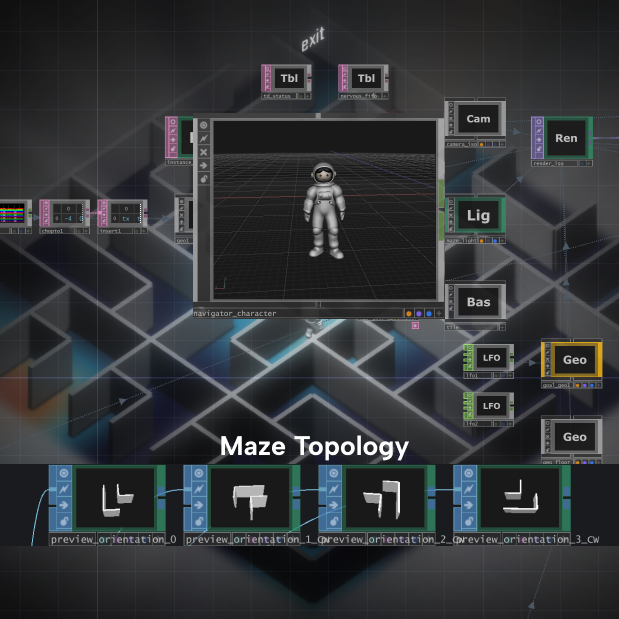
Preproduction research for Nervous Maze – What tile topology, when instanced into a field of agents, may produce the most indeterministic system behavior?
Nervous Maze 前期制作研究 —— 何种单元拓扑结构,在以几何实例化(geometry instancing)的方式布满整个 agent 场时,可能产生最不确定的系统行为?
keywords: maze, field, topology, spatial pressure, local rules (in preparation for MARL, environment-as-agent, movement before semantic representation, movement-first system behavior, stigmergy)
1. A Quadruple Primitive 四重体
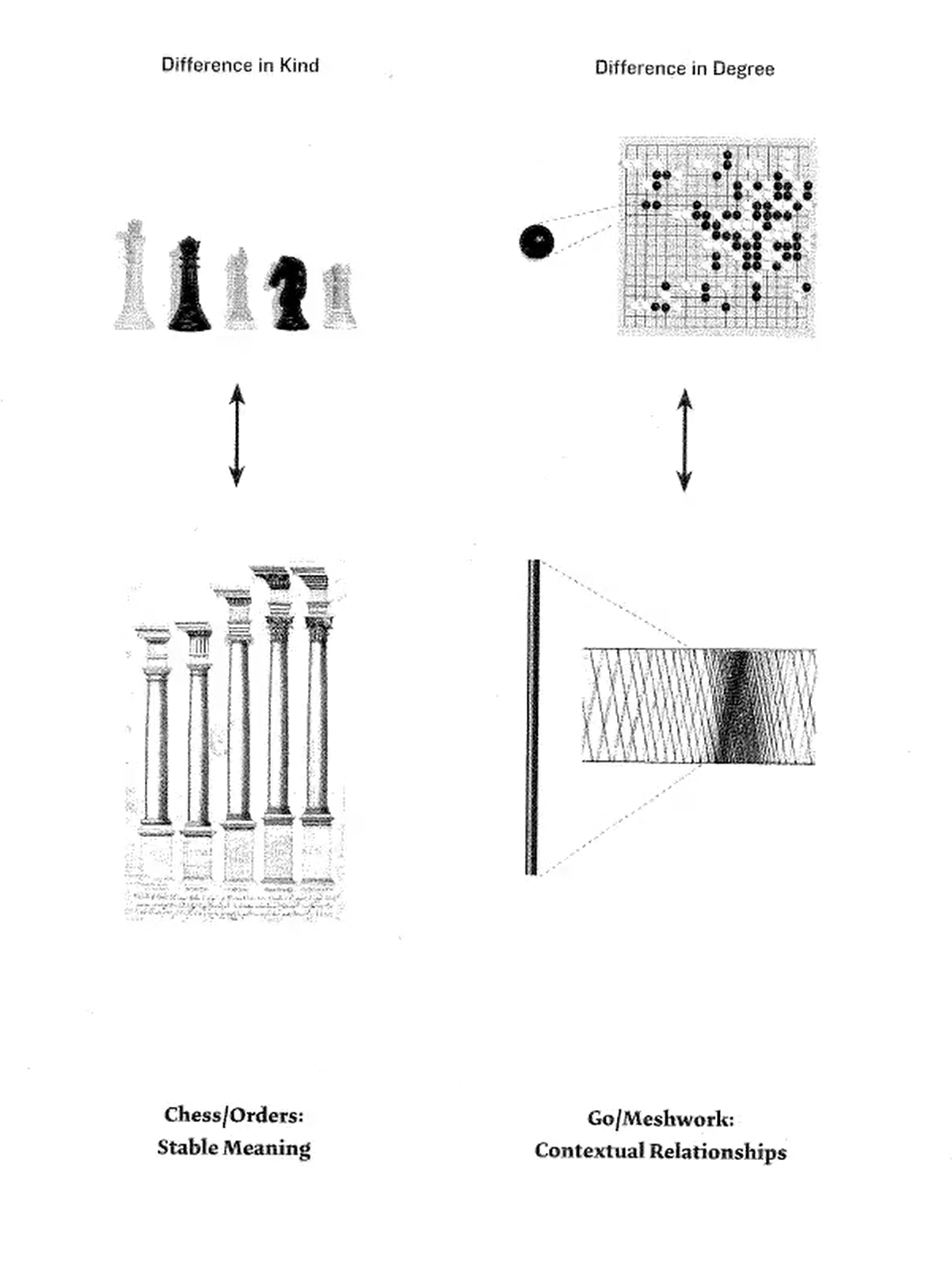
A maze made from the geometry instancing of one single tile topology has the most indeterminate emergent system scenarios. An easy analogy is chess vs. go: each chess piece is a different identity, represented by different geometries, distinguished by different chessboard coordinates and behavior rules. A go piece, by contrast, is not distinguished in identity from any other go piece, but distinguished by dynamic contextual relationships. My Polytropos series of work (A.K.A. 2021 Moving Maze and 2026 Nervous Maze) is also a substrate of contextual relationships.
One continuation becoming a fork;
a fork collapsing into one continuation;
one branch closing while another opens;
a nearby branch structure moving spatially.
These are all produced by contextual temporal relationships.
Because this maze topology study is a pre-study for my Polytropos series, the topology study assumes that a unit has only four cardinal orientations:
0°, 90°, 180°, 270°
The natural architectural primitive is therefore a 2 × 2 grid, a quadruple object, borrowing the term quadruple from Object-Oriented Ontology (Graham Harman).
I designed the primitive by defining its components:
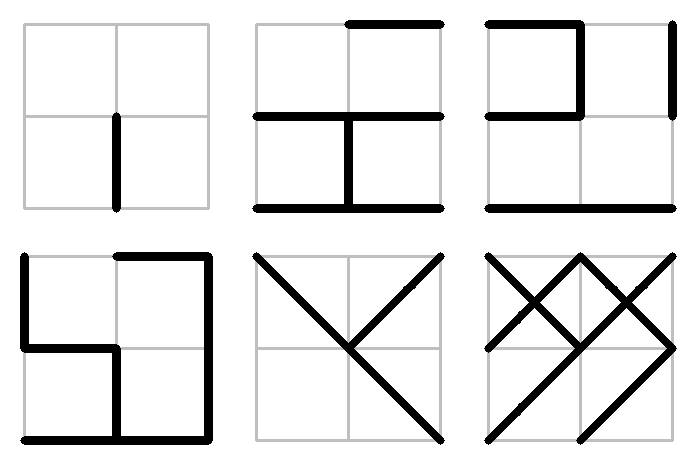
If inside one subcell, one int and one ext diagonal cross, then compositionally, it can be subdivided into four segments joining at the center. My design purpose was to find the smallest indivisible quadruple primitive. The smallest quadruple is a 4-cell unit, giving it a clear geometric center, 4 possible internal edges, 8 possible ext edges, 4 int diagonals and 4 ext diagonals. an edge can be seen as a line segment defined by two points: 1 start and 1 end. The difference in start-end positions is sufficient to tell apart any two edges. They have unified height and wall width so nothing other than start-end positions distinguish them. That’s a clean primitive.
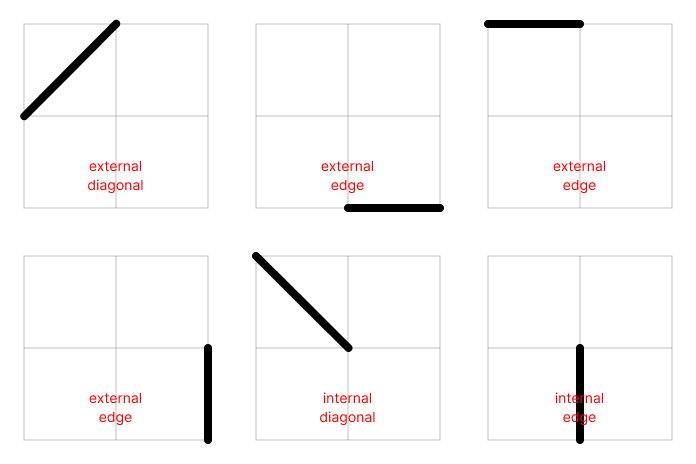
Built a topology space of 1014 different single tiles.
The moving image is a long sequence flipping through the 1014.
2. From Controlled Field Ensemble to Controlled Navigator Test
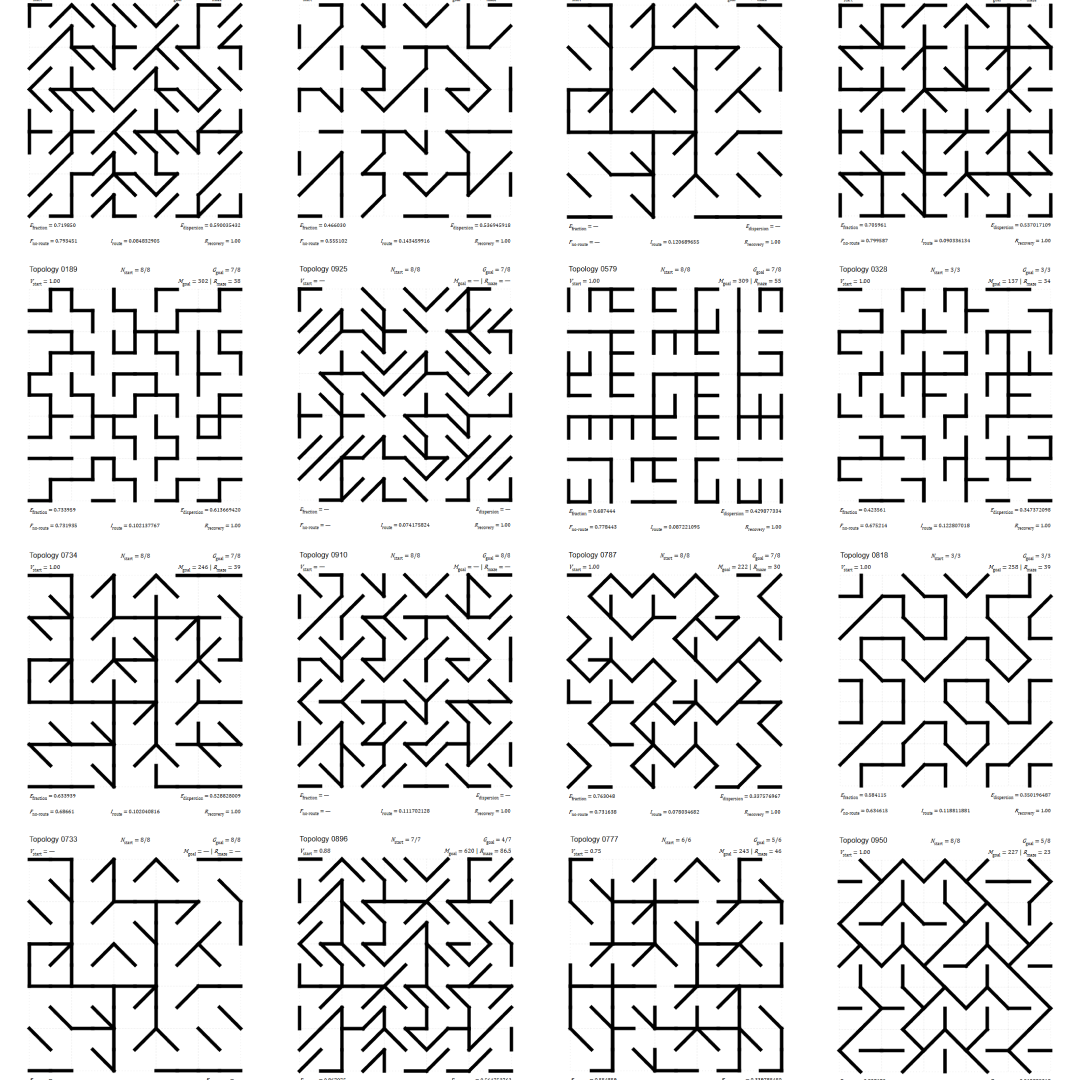
A data-driven screening of 1014 candidate maze-tile topologies for Nervous Maze, a reinforcement-learning environment where the maze itself acts as an adversarial agent. Rather than trusting the A* navigator’s own test results as ground truth, I built an independent ranking method that separates genuine topology quality from evidence artifacts: a Wilson-corrected viability score (penalizing thin trial counts), two empirically non-redundant contestability signals (sustained route scarcity and response-level route disruption), and an explicit checkmate penalty. The result is a reproducible top-30 shortlist and a full evidence trail that fed directly into selecting the tile geometry for the project’s next RL training milestone.
Methods: statistical ranking under small-sample correction, redundancy analysis across candidate metrics, data visualization.
3. Tile Loader for RL
As the maze swaps its tile topology, the border conditions and inner walkable space change. Even with the reward structure unchanged, the topology transforms local sensing of each action’s open path consequences and navigator action options. Much of the creative work in this study aims for the selection and preparation of the Nervous Maze RL back end to correctly recognize the inner partition and edge open port, wall endpoints, and make relationships between inner partitions and edge conditions. I developed a unified approach to prep each selected tile.