2022 – 2025
An animist worldbuilding vocabulary deverloped mainly from 2022-25 where body and environment are mutually formative, and sentient presence is reactivated through technology.
Technology is not defined by novelty or electronics. Technē means craft, technique, protocol or a reproducible method for bringing something into being. It can be a protocol for transforming matter, perception, consciousness, identity, uncertainty, or relations. During the years of 2022 till around 2025 while I frequently collaborated with dancers and peerformance artists, I focused on building a techno-mythic world vocabulary: synthetic organisms, hybrid bodies, metempsychosis. Technology is a helper in deciphering and re-structuring mythology; mythology is the tacit framework each of us use to know this world and behave within it. I retrospectively term this period Ancient Future Myth.
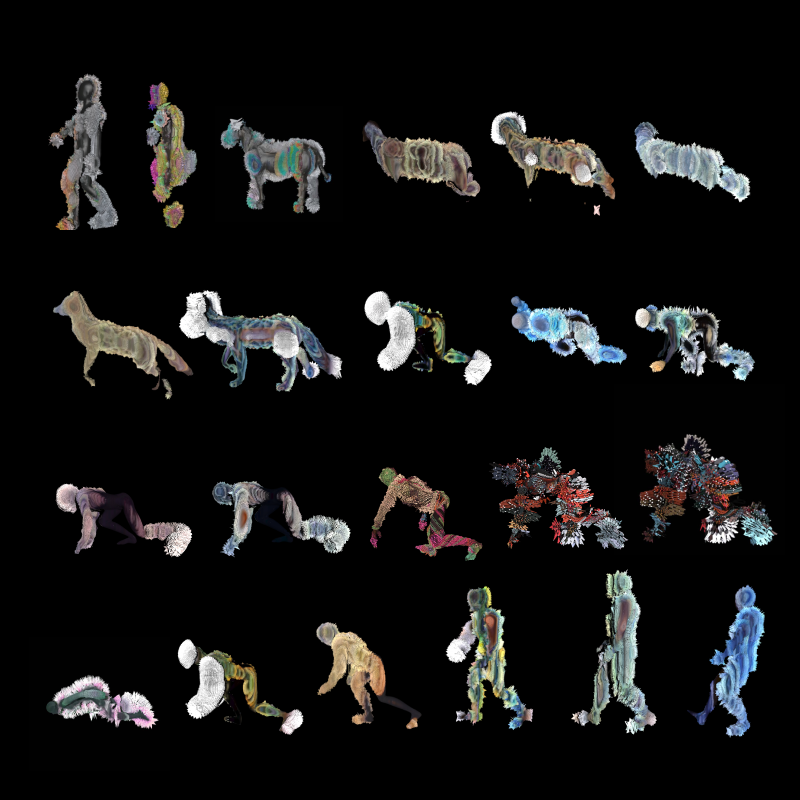
Metamorphosis is the central axis of this period. Transformation operates both morphologically and behaviorally, where movement is the externalization of identity. Works include Water Always Goes Where It Wants to Go, Noma Tongues, Mixanthropy, and Tidal Spine.
Research publications: 2024, “Bodies of Hybridity: Animal, Cyborg and the Supernatural Becoming”
Abstract: In mythology, the hybridization of human forms of body with animalistic traits is closely tied to the ontology of supernatural power, while animals and robots share a similar moral status as other bodies considered inferior to humans. Today, technological advancements allow humans to negotiate between the other and the divine through machines or robotic body implants, creating cyborgs. The chapter investigates the supernatural becoming between animals and cyborgs, closely examining the origins of divinity in hybrid metamorphic deities found in different mythologies and multimedia art forms. Examples include animalistic deities in Hinduism and Buddhism, as well as their techno-digital reincarnations in the works of Tianzhuo Chen, Andrew Thomas Huang, and Lu Yang. The chapter explores cyborgs’ mythological significance in Ken Liu’s Good Hunting. It analyzes shapeshifting figures in our work Mixanthropy where form-motion synchronicity becomes a driving force for creative deification. Finally, it examines familial relations between animal-human, organism-machine, and the deified persona. Ancient mixanthropic spirits transition divine powers from animal-human to organism-machine amalgamations in the Digitocene paradigm. Robots and cyborgs have an occult dimension that resurrects mythological beliefs through the supernatural becoming, where technological enchantment replaces nature’s unfathomable depths while maintaining the supernatural persona.
In A. Malakasioti & C. Kokkiou (Eds.), Beauty and Monstrosity in Arts and Culture. London: Routledge.